

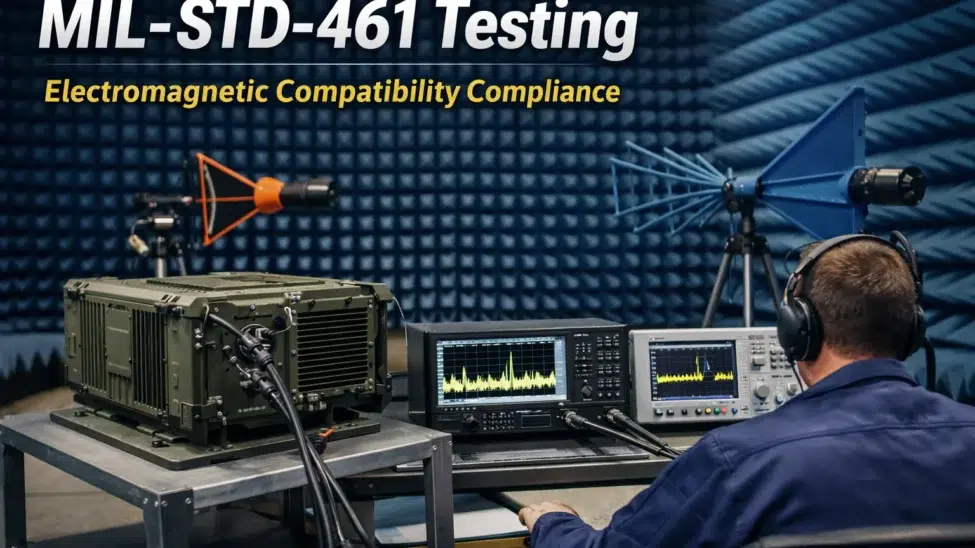
MIL-STD-461 Testing | Complete EMC Compliance Guide
MIL-STD-461 Testing: The Complete Guide to Electromagnetic Compatibility Compliance
Introduction to mil-std-461 testing
mil-std-461 testing is a critical requirement for ensuring electromagnetic compatibility (EMC) of electronic and electrical equipment used by the U.S. Department of Defense (DoD) and military organizations worldwide. This standard defines the limits and test methods for controlling electromagnetic interference (EMI) characteristics of subsystems and equipment.
As military platforms become increasingly complex and electronics-dense, mil-std-461 testing has become essential for guaranteeing mission reliability, operational safety, and interoperability across land, sea, air, and space environments.
This article provides an in-depth, authoritative, and SEO-optimized overview of mil-std-461 testing, covering requirements, test methods, procedures, applications, and best practices.
What is MIL-STD-461?
MIL-STD-461 is a U.S. military standard titled:
“Requirements for the Control of Electromagnetic Interference Characteristics of Subsystems and Equipment.”
The purpose of mil-std-461 testing is to ensure that equipment:
- Does not emit excessive electromagnetic interference
- Is immune to external electromagnetic disturbances
- Can operate reliably in harsh electromagnetic environments
Why mil-std-461 testing Is Critical
1. Mission Reliability
Military systems operate in high-risk environments where electromagnetic interference can cause system failure, data corruption, or loss of control.
2. System Interoperability
Multiple electronic systems must function simultaneously without interfering with one another.
3. Regulatory Compliance
mil-std-461 testing is mandatory for most defense contracts and procurement programs.
4. Lifecycle Cost Reduction
Early EMC compliance reduces redesign costs and deployment delays.
Who Requires mil-std-461 testing?
- Defense contractors
- Aerospace manufacturers
- Naval system suppliers
- Ground vehicle integrators
- Space and satellite system developers
- Homeland security and NATO partners
Overview of mil-std-461 testing Revisions
| Revision | Key Characteristics |
|---|---|
| MIL-STD-461C | Early standardization of EMI limits |
| MIL-STD-461D | Improved test consistency |
| MIL-STD-461E | Expanded susceptibility testing |
| MIL-STD-461F | Enhanced radiated testing |
| MIL-STD-461G | Current revision, widely used |
Most modern mil-std-461 testing programs reference MIL-STD-461G.
Categories of mil-std-461 testing
Conducted Emissions (CE)
Measures unwanted electromagnetic energy conducted through power lines.
Conducted Susceptibility (CS)
Evaluates equipment resistance to conducted electromagnetic disturbances.
Radiated Emissions (RE)
Assesses electromagnetic energy emitted into free space.
Radiated Susceptibility (RS)
Tests immunity to external radiated electromagnetic fields.
Detailed mil-std-461 testing Methods
CE101 – Conducted Emissions, Low Frequency
- Frequency range: 30 Hz to 10 kHz
- Typical for power input lines
CE102 – Conducted Emissions, High Frequency
- Frequency range: 10 kHz to 10 MHz
- Applies to AC and DC power leads
CS101 – Conducted Susceptibility, Low Frequency
- Verifies equipment tolerance to low-frequency interference
CS114 – Bulk Cable Injection (BCI)
- One of the most critical mil-std-461 testing methods
- Frequency range: 10 kHz to 200 MHz
CS115 – Impulse Excitation
- Simulates fast transient disturbances
CS116 – Damped Sinusoidal Transients
- Models lightning and switching transients
RE101 – Radiated Emissions, Magnetic Field
- Low-frequency magnetic emissions
RE102 – Radiated Emissions, Electric Field
- High-frequency radiated emissions up to 18 GHz
RS101 – Radiated Susceptibility, Magnetic Field
- Low-frequency magnetic immunity
RS103 – Radiated Susceptibility, Electric Field
- High-intensity RF field exposure
- Critical for radar and communication environments
mil-std-461 testing Test Setup Requirements
Test Environment
- Shielded anechoic chamber
- Semi-anechoic chamber
- Shielded room with grounding plane
Equipment Under Test (EUT)
- Fully operational
- Configured in worst-case EMI mode
Calibration
- All test equipment must be traceable to national standards
mil-std-461 testing Procedure Overview
- Requirements analysis
- Test plan development
- Pre-compliance testing
- Formal mil-std-461 testing
- Data analysis
- Compliance report generation
Common Challenges in mil-std-461 testing
- Cable management complexity
- High-frequency measurement accuracy
- Grounding and bonding issues
- Test repeatability
- Cost and schedule constraints
Best Practices for Successful mil-std-461 testing
- Integrate EMC design early
- Use shielded cables and connectors
- Implement proper grounding strategies
- Perform pre-compliance testing
- Collaborate with accredited EMC labs
mil-std-461 testing vs Commercial EMC Standards
| Feature | MIL-STD-461 | CISPR / FCC |
|---|---|---|
| Environment | Military | Commercial |
| Severity | Very High | Moderate |
| Frequency Range | Up to 18 GHz | Typically lower |
| Test Levels | Extreme | Limited |
Industries Benefiting from mil-std-461 testing
- Aerospace & Defense
- Avionics
- Naval Systems
- Tactical Communications
- Space Systems
- Autonomous Military Vehicles
Cost of mil-std-461 testing
Costs vary depending on:
- Number of test methods
- Equipment complexity
- Test duration
- Facility type
Typical ranges:
- Small subsystem: $20,000 – $50,000
- Large system: $100,000+
Future Trends in mil-std-461 testing
- Increased frequency coverage
- Cyber-electromagnetic convergence
- AI-driven EMC diagnostics
- Stricter immunity requirements
- Space environment adaptation
FAQ: mil-std-461 testing
What is the purpose of mil-std-461 testing?
To ensure military equipment does not emit or suffer from electromagnetic interference.
Is mil-std-461 testing mandatory?
Yes, for most U.S. DoD and allied military contracts.
How long does mil-std-461 testing take?
From several days to multiple weeks depending on complexity.
Can commercial products pass mil-std-461 testing?
Usually not without design modifications.
Conclusion
mil-std-461 testing is a cornerstone of military electromagnetic compatibility assurance. It ensures that mission-critical systems perform reliably in the most demanding electromagnetic environments.
By understanding test methods, requirements, and best practices, manufacturers can achieve compliance efficiently while reducing risk, cost, and time to deployment.
For any defense or aerospace program, mil-std-461 testing is not just a requirement—it is a strategic necessity.


